







![JV boys soccer goalie sophomore Bear Brummett does a goal kick. Normally, Brummett plays defense, but when starting goalie sophomore Kurt Schratweiser missed a match due to illness, Brummett was thrust into the role. “[Brummett] did a great job, especially considering he hadn’t played the position in so long,” Head Coach Casey McDonough said.](https://spschronicle.org/wp-content/uploads/2026/01/image2-1200x800.jpg)








The middle school volleyball team had a successful
season overall. Of course, their wins mattered,
but it wasn’t victory that was on their minds. They
were down four to seven. Then they scored, five to
seven. The bench practically quivered with anticipation.
Not because they would catch up, but because they
wanted — no — NEEDED just one more point. That
one number.
It seemed like time moved in slow motion when
the ball flew over the net, inches from the ground,
centimeters, until finally…it hit the court.
In the blink of an eye, the scoreboard changed.
This was it. The moment they had all been waiting for.
The scoreboard read…
Six to seven.
The bench burst into screams, laughter, chaos, even tears. One player picked up her teammate and frantically ran around the bench. Six-seven. The one phrase that makes everyone lose all common sense.
“They were more excited about that moment than any of the wins we got during the season,” US Math Teacher and Middle School Volleyball Coach Sarah Anderson said.
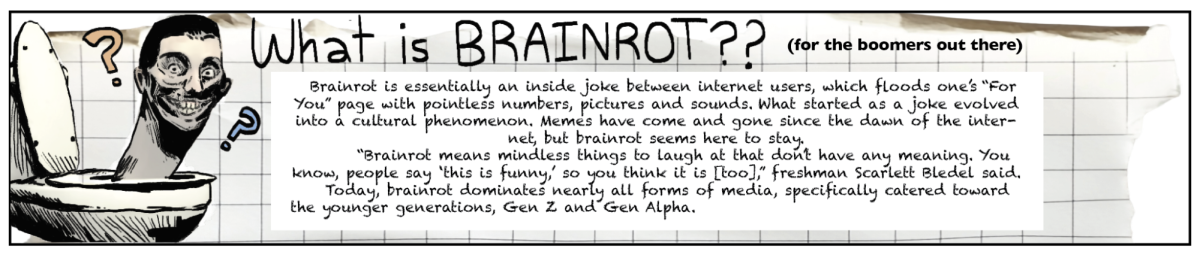
If you haven’t already, look up at the upper left-hand side of the page. Now look to the right. You’re probably rolling your eyes, or maybe we got a laugh from you. If we did, congratulations, your brain is officially rotted. Either way, we couldn’t write an entire article about brainrot without mentioning six-seven.
The term originated from a song by Skrilla, “Doot Doot (6 7),” which is a reference to 67th Street in Philadelphia. The song gained immense popularity through edits of basketball player LaMelo Ball, whose height happens to be, you guessed it, 6’7”. Although it has no meaning, six-seven has taken the internet by
storm and transformed into a full-on global sensation. Today, six-seven isn’t just a number — it’s a mindset. You either get it or you don’t.
“We don’t have time to sit and chuckle for two full minutes about six-seven again,” US English Teacher and 11th Grade Dean Natalie Updike said, who can’t seem to last a day without her 17 and 18-year-old seniors yelling out “six-seven!” in her classroom. In fact, Updike has a system of points that she awards to students who win games in her class, and she removes a point from any student who says six-seven in her class. And if you think she has it bad, think about the math teachers.
Have you ever seen a funny video on TikTok, perhaps an AI-generated shark chanting “tralalero tralala” with an Italian accent? Maybe you laughed a bit and then watched it ten more times and sent it to everyone you know? Congrats, you just officially did your part in spreading the brainrot virus even further. Every like, share and view sends signals to the algorithm that this intelligence-reducing content is worthwhile. Before you know it, your nine-year-old cousin’s YouTube Shorts feed is filled with the same junk as yours.
Social media platforms like TikTok and Instagram see engagement, including your three a.m. scrolling sessions, as an opportunity to push the content to others.
How does it “rot” our brains?
Short-form content is scientifically proven to lower the attention spans of teenagers. As brainrot continues to gain popularity, the ability to focus on anything longer than a TikTok is likely to be difficult.
“I used to be able to assign a reading of [around] 30 pages, and no one would blink an eye…whereas now students are like, ‘30 pages, it’s so much,’” Updike said.
Every time you laugh at a “Tung Tung Tung Sahur” video, your brain gets a small hit of dopamine. The short-form content leaves viewers craving more, since the temporary “high” of dopamine is positive for the brain. Before you know it, you’ve been scrolling for four hours. Anyone can fall victim to doomscrolling, which makes paying attention to longer-form information more difficult than you think.
Generational divides and connections
Explaining “SYBAU” to your parents most likely causes confusion, concern and the whole “this is why you’re the least favorite” talk.
It’s fruitless trying to explain anything brainrot-related to someone who doesn’t spend most of their week in a high school.
Older generations had jokes, they were just different and less mind-numbing. Back then, social media and current technology didn’t exist, so jokes had to be passed by word of mouth, radio shows, TV sitcoms, magazines or messenger pigeon.
This disconnect between generations can make it feel like there’s an invisible wall between us and “the boomers”. However, while brainrot separates the younger generations from the older ones, it has also helped Gen Z and Gen Alpha build their own identities.
Regardless of age, brainrot can unite anyone who is online enough to understand and appreciate the absurdity of this global phenomenon.
“I think finding random things silly and funny is universal,” Anderson said.
Whether you’re a diehard fan or D1 hater, the humor behind brainrot is unifying. These jokes can be more than just something that makes us chuckle — they can make us feel seen.
In a survey of 95 Shorecrest students, 53 percent found brainrot funny. Laughing over an online brainrot joke with someone has become a new form of bonding. Finding these jokes hilarious, or even stupid, helps you connect with others of the same opinion.
Even those older generations, the ones who seem to be excluded from this epidemic, can connect with younger people through an adopted understanding of memes.
“Once [adults] really catch the hang of [brainrot] and start using it, they’re connecting themselves with us,” sophomore Tanyiah Ellison said.
So no, two people laughing over the same meme isn’t just shared humor; it’s shared delusion. And that delusion is what brings us together.
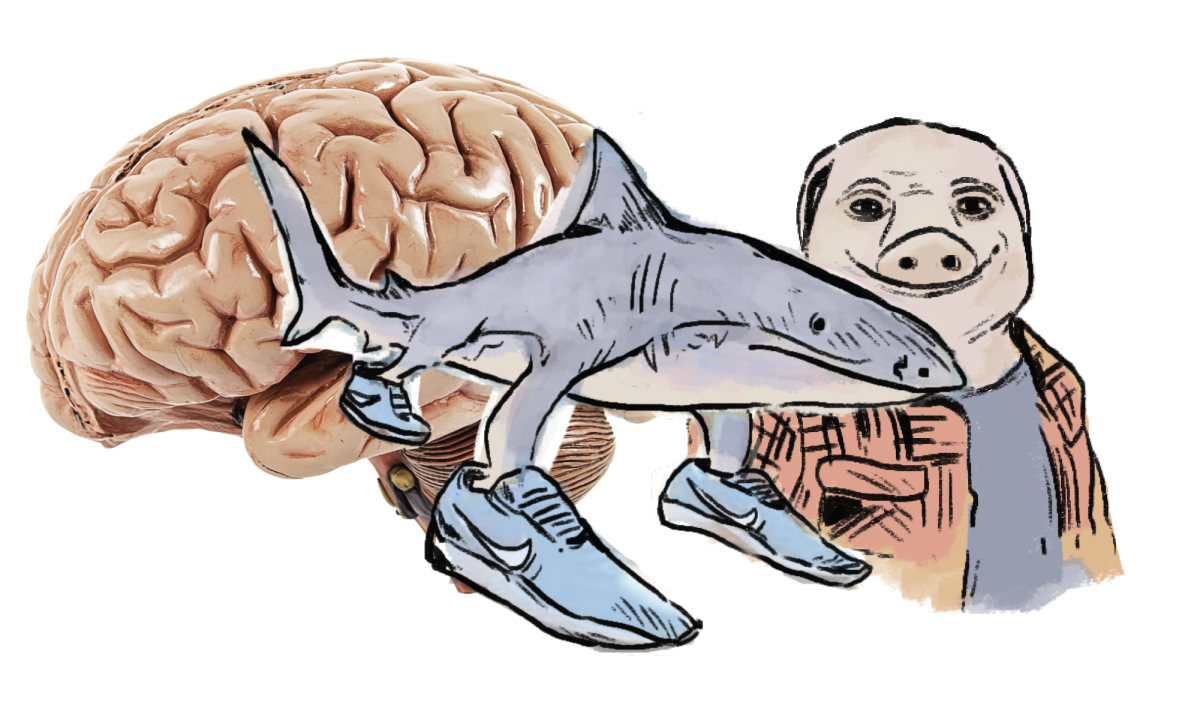
Is it possible to “de-rot” my brain?
Before panic sets in, relax. The virus can be cured.
First things first, to “de-rot” your brain, you don’t have to throw your phone away and start living in rural Mongolia.
Having some discipline is a good start. Take small breaks, put your phone down or go outside and touch some grass. Read something longer than a TikTok caption, like maybe a couple newspaper articles. HA! You’re already halfway there!
The human brain is capable of more than soaking up niche meme references, so use it to its full potential. Take a breath, pick up a book and enjoy a real-life interaction. Your brain might be a little rotted, but it’s far from gone.



Heather Elouej • Jan 5, 2026 at 3:44 pm
This was a pleasure to read, and Harper’s illustrations are (as always) amazing.