







![JV boys soccer goalie sophomore Bear Brummett does a goal kick. Normally, Brummett plays defense, but when starting goalie sophomore Kurt Schratweiser missed a match due to illness, Brummett was thrust into the role. “[Brummett] did a great job, especially considering he hadn’t played the position in so long,” Head Coach Casey McDonough said.](https://spschronicle.org/wp-content/uploads/2026/01/image2-1200x800.jpg)







Melinda Kim traveled more than 13 hours from her home in Incheon, South Korea, to attend the Ross Mathematics Program in Terre Haute, Ind. this past summer. The 18-year-old said she left the six-week pre-professional program nearly three weeks early to attend another summer college preparatory program: University of Pennsylvania’s Management and Technology Summer Institute.
Kim isn’t alone. A growing number of high schoolers from all over the world are choosing to spend large parts of their summers studying at pre-college programs.

Summer programs have become commonplace for both universities and students alike. All of U.S. News’ top 40-ranked schools offer programs in the summer for high school students, ranging in focus from dance and law to climate change and rocket science. Brown University alone brings in more than 6,000 students per year for 300 different pre-college course topics.
The number of students attending pre-college summer programs has increased in recent years. According to a study by the American Association of Collegiate Registrars and Admissions Officers, over a three-year period, almost half of its member schools increased the number of pre-professional programs they offer. Some students apply for summer programs hoping they’ll stand out on their resumes and, ultimately, give them an increased chance of acceptance into universities.
Harry Tidgewell is an 18-year-old Syracuse University freshman from Albany, N.Y. He was a student at Syracuse Summer College for sports broadcasting in 2024, and he thought participating in summer enrichment activities throughout high school made him a more attractive applicant to colleges.
However, Tidgewell added that several students from his summer class did not get admitted to Syracuse University despite attending the two-week program.
In an ever-evolving landscape of college admissions, senior Simi Damani uses summer programs as an opportunity to get a leg-up on applications.
Nonetheless, according to Daphne Braun, the director and founder of Montana-based college counseling company Elska Consulting, there is no direct connection between summer program attendance and college acceptances.
“We have to be careful not to confuse correlation and causation,” she said.
Some students, like Tidgewell, know this and are motivated to attend programs to learn more about their field of interest.
“The only thing that really makes these summer programs worth it is having the opportunity to learn more about a field that you’re interested in,” he said.
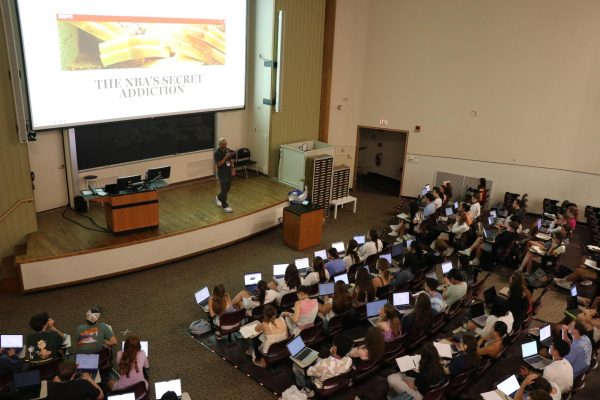
Enterprise Reporter for The Wall Street Journal Emily Glazer was a Cherub at the Medill-Northwestern Journalism Institute in 2005. The lead reporter for a Pulitzer Prize-winning team, Glazer attributes part of her success to her time at the summer program.
“Cherubs was a real foundation of my journalism training,” she said. “I’m achieving some of the things that were my goals the summer that I was there.”
Another benefit of pre-college programs is that they allow high schoolers to temporarily live like a college student. Students may decide what they like or don’t like about certain schools, allowing them to tailor their applications accordingly. Damani said she attended a University of Pennsylvania program called Leadership in the Business World this past summer for that reason.
“The school is a school I’ve been interested in applying to, and so I wanted to go and see if I liked the campus and if I could see myself there,” she said.
Tidgewell had similar motivations for attending his program.
“I definitely wanted to make sure it was a place I could see myself,” he said. “I felt that living on campus for just a couple of weeks could really boost my comfortability.”
Elizabeth Hannan, the Director of College Counseling at Saint Ann’s School in Brooklyn, N.Y., said she thinks the benefit of pre-college programs lies more in personal development than resume building.
“It’s just not that big of a boost for college admissions,” she said. “It’s more [of] a boost for the student to really get a little bit of a taste of undergraduate life.”
The greatest beneficiary of summer programs, however, is the universities that host them. Schools are able to fill buildings that would otherwise be empty during the summer, gain potential future applicants and keep faculty and staff working while students are on break.
“You’ve got all these buildings, you have a name brand and they’re empty for three months. It would be stupid not to fill it with people,” Braun said.
Universities gain millions every year from programs that last as little as a few days. The University of Chicago’s four-week biological research program costs $14,490. Meanwhile, one semester at nearby Elgin Community College would cost about $11,133.
Students and adults alike aren’t hesitant to point out the steep prices, especially if certain programs don’t make a difference for college admissions. Still, the demand for any perceived leg-up makes students return to summer programs year after year.
“Some colleges are definitely taking advantage of people’s willingness to pay,” Damani said.
The price of some programs may prevent qualified students from being able to attend them. Universities take advantage of this high willingness to pay, preventing those without sufficient financial means from getting the summer college experience.
“They tend to be very expensive and very few offer financial aid,” Braun said. “It’s very much a pay-to-play model. In my opinion, they’re a little predatory.”
Students may miss out on experiencing what it’s like to be a college student, making new friends or any potential application boost solely because their families can’t afford what schools charge for their programs.
Sixteen-year-old Anastasia Marinopoulos — who attended Shad Canada, a STEM and entrepreneurship program at Toronto Metropolitan University, this past summer — said she thinks it’s unfair that students can have all the right attributes and skills to excel in a pre-college program, but are not able to go because of cost.
“There needs to be some sort of regulation on how much these universities are allowed to charge their students because $10,000 for four weeks — that’s somebody’s salary,” she said.
Despite the price, some students feel immense pressure to attend summer programs. They feel that, if they do not, they will be behind and compare poorly to other college applicants.
“I worry about students getting stressed out and thinking summer programs matter more than they do,” Braun said.
She suggested that high schoolers do other things during their summers. Getting a job, internship or volunteering at a non-profit shows initiative and desire to learn during time off from school. Braun said these methods help students stand out to universities more than attending a summer program and can help avoid having to pay thousands for just a few weeks.

Charlie Cowan • Jan 5, 2026 at 8:44 pm
I think that this article is very interesting. Obviously having been apart of Shorecrest during high school, I absolutely am able to recognise the pressure that there is to do these summer programs. There is always one additional thing you should be doing during your free time or something that you are supposed to be doing better at so you can boost your chances of getting into a “good” college. It even surprises me reading this that Daphne Braun said she doesn’t necessarily believe there is much of a correlation between doing a summer program and getting into that school.
Good job Braden.