



![JV boys soccer goalie sophomore Bear Brummett does a goal kick. Normally, Brummett plays defense, but when starting goalie sophomore Kurt Schratweiser missed a match due to illness, Brummett was thrust into the role. “[Brummett] did a great job, especially considering he hadn’t played the position in so long,” Head Coach Casey McDonough said.](https://spschronicle.org/wp-content/uploads/2026/01/image2-1200x800.jpg)







Monday, Oct. 27: the fateful date that the news hit group chats schoolwide. ChatGPT was officially banned on school laptops. A flurry of texts read, “Watch my grades drop,” and “I’m going to fail,” as students seemed to watch their lives flash before their eyes.
By Tuesday, Spotify, Pinterest and Amazon were blocked. For some, it felt like “the end.”
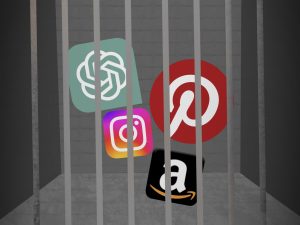
Then on Wednesday, they were all back. Students had no clue what happened, but as long as their beloved “Chat” was back, all was well.
As it turns out, on Monday — as explained by Dean of Faculty and Curriculum Dr. Anna Baralt — the Information and Technology (IT) and Educational Technology (Ed Tech) Departments were sent a list of applications to discuss blocking at a meeting on Tuesday. The departments, believing the list to be applications they needed to block immediately, promptly took them off student laptops. Realizing the mistake, they unblocked them. However, on Friday, ChatGPT was blocked again.
Students did not know what happened or why the school banned these applications. This is one of the reasons why students became so confused and angry after the initial blockages. While the event was an accident, students lamented how they aren’t always informed why they can’t access sites on their computers. One day, the app just disappears, like Netflix did over the summer.
For the most part, students are used to this and have made adjustments. “If I want to watch [something] like Netflix, then I’ll watch it on the TV or on my phone or something. I feel like [our laptops] are restricted [because] it’s a school resource, so I try to keep it to that,” freshman Zoe Eichenbaum said.
According to Dr. Baralt, there are three main reasons why applications are blocked on school-issued devices: legal requirements, bandwidth and malware.
Shorecrest is responsible for upholding many laws, such as the Children’s Online Privacy Protection Act (COPPA), which prevent children under 13 from using certain applications — mainly social media. Since Shorecrest is a Pre-K-12 school, and students of all ages have devices issued to them, Shorecrest blocks apps like Instagram, Snapchat and TikTok. 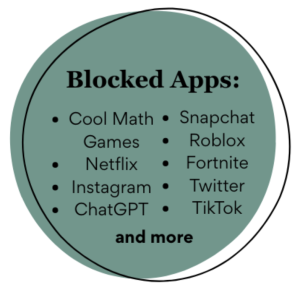
Shorecrest also has blocked apps and websites to ensure that the school continues to have efficient Internet. Certain apps, especially Roblox and Netflix, use up more of the bandwidth, or the maximum amount of data that can be transmitted at one time.
And, for obvious reasons, applications that contain viruses or malware that could “infect” the school network are blocked.
Shorecrest found that the AI platform ChatGPT has data protection issues, which the school thought posed enough danger to block.
Still, students wonder why they cannot use certain blocked applications at home, like applications that are only blocked because they slow down the school’s Wi-Fi.
“I think the point of the bans is to stop people from [going on certain applications] during class, and I think when you’re at home, on your free time, you should be able to use [them],” sophomore Danny Keane said.
Some students have a separate device or TV at home where they can play games or watch a show. But for others, this is their only device. Students pay the same amount for their laptops as a normal MacBook without any blockages.
For the most part, though, students have accepted the situation, and most don’t believe there could be another way. “The iPads that we had in middle school already [had] restrictions on them. So, I guess I’m kind of used to it. I don’t really know, though, if [the experience] is different for someone else who’s new and might not have restrictions on their technology, but I was pretty used to it,” Eichenbaum said.
The main cause of annoyance seems to be blocks occurring suddenly and without any warning, as historically, Shorecrest students are usually given advanced warning for policy changes.
“When we developed our ‘Responsible Use Policy’ many years ago, I actually had students be included in that group. So, the students actually helped us write our ‘Responsible Use Policy,’” Baralt said. “And, so I do believe that student voices are important.”