



![JV boys soccer goalie sophomore Bear Brummett does a goal kick. Normally, Brummett plays defense, but when starting goalie sophomore Kurt Schratweiser missed a match due to illness, Brummett was thrust into the role. “[Brummett] did a great job, especially considering he hadn’t played the position in so long,” Head Coach Casey McDonough said.](https://spschronicle.org/wp-content/uploads/2026/01/image2-1200x800.jpg)





Editor’s Note: Some names in the article are pseudonyms for safety. The interview with Maria was conducted in Spanish and has been translated with help of HappyScribe for clarity.
An Invisible Crisis
In the hallways of Shorecrest, stories about Immigration and Customs Enforcement (ICE) feel like distant problems — headlines and anecdotes far removed from a suburban preparatory school. And yet, few of us realize that the deportations are affecting members of our own community.
Upper School student Chloe, the daughter of a first-generation Venezuelan immigrant, for example, often fights back tears, fearing the deportation of her aunt who helped raise her and could be taken from her with a sudden knock on her door.
ICE is sometimes treated as a punchline in casual jokes, but for Chloe, the reality is far from funny. She recalled a friend of hers expressing his frustration with immigrants, mentioning his support of the spike in ICE raids.
“I asked, ‘What if I told you I had come here illegally from Venezuela?’ He said, ‘Well, I wouldn’t want to be associated with you.’ That just changed my whole perspective on him, and it made me think [about] how corrupted minds are becoming,” she said.
Policy and Paradox
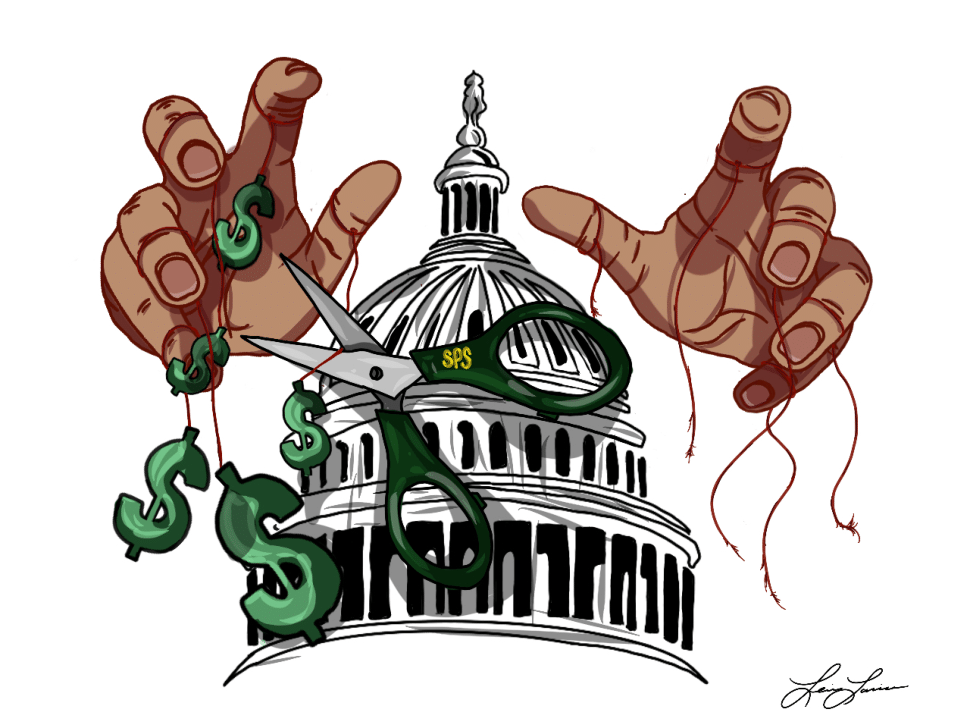
Chloe has been living in a constant state of worry since President Donald Trump returned to the White House last January and has moved to fulfill his goal of “carry[ing] out the largest domestic deportation operation in American history,” as he first said during a campaign speech in 2023. His administration has rapidly scaled up enforcement, targeting over 10 million undocumented migrants living in the United States, redirecting billions of dollars to fund ICE since his inauguration roughly one year ago.
“People think that just because we go to a nice school and we’re privileged, that we’re not also struggling with things like [deportations]. I’m extremely lucky, and my parents have worked so hard for what they have, and I’m so grateful for that. But, so much of my family has not been that lucky,” Chloe said.
One of those family members is her aunt, Maria, who has to return to the rocky political climate of her home country of Venezuela.
In 2018, the United States welcomed her. She was granted Temporary Protected Status (TPS), which allows foreigners to enter the country without fear of deportation if their countries are facing dangerous conflicts.
“My expectations were [that] I [was] going to be protected. And that’s what happened. I was protected. I’m with my family, but legally I have no choice but to return, even though I don’t want to return with what’s happening now in Venezuela,” Maria said.
Under the persistent efforts of the current administration, that protection has vanished. She wasn’t able to renew her TPS status and was denied asylum, which has left her to choose between returning to Venezuela independently or facing deportation. She agrees with the government in the sense that she believes criminals should be removed but thinks the system has lost its ability to distinguish what those threats are.
For Chloe, the effects aren’t physically threatening, but traumatic nonetheless. She has had to balance what she described as a “double life.” Normal teenage things like classes, homework, drama and extracurriculars don’t pause now that she’s forced to navigate complex emotional situations at home. The impacts have been similarly complicated, grief fueled by generational duty and the frustration of being too young to act.
“To see that happen to my people, especially right now, it makes me feel powerless. I’m a [highschooler], there’s probably not much I can do. It really hurts me to see that happening to my family,” she said.
However complicated Chloe’s situation is in the United States, the stakes for her aunt are far greater. The threat isn’t solely about paperwork or politics, but a battle that follows her across every border.
Battles Beyond Borders
Before Hugo Chávez’s presidency, Maria’s life in Venezuela was defined by her achievements in law. She was an accomplished criminal lawyer, possessing two law degrees and a position in the government.
“I worked for the government, but once I opposed them, they fired me and persecuted me, and because of that persecution, I had to come to the United States,” she said. “I could no longer stay there because my life was in danger.”
While in Venezuela, Maria was a voice of opposition, a history that haunts her even now. Her greatest fear is “that the regime knows of my presence in Venezuela and what I have fought against them and been imprisoned for,” she said.
She finds herself in a tragic paradox: The United States opposes the regime she fled, so much that they used a military campaign to depose it, yet actively tries to send her back to it.
When she left, she was forced to leave her daughter and granddaughter behind in a nation torn by conflict. Her daughter feared the same persecution and can rarely speak about her mother to anyone in her life. For Maria, leaving her country included losing the sense of self she had worked so hard to build.
“That’s the hardest part. Leaving my daughter, my granddaughter, and thinking that I had fought so hard to study, and that I could no longer practice my career as a lawyer,” she said.
Recent events in Venezuela, including the capture of Nicolás Maduro, have brought a complicated mix of anxiety and relief. Though Maduro is gone, he has been replaced by his vice president, who shares many of his ideals.
“I am very hopeful about this arrest because the international criminal courts did nothing to prosecute him, to convict him, and the human rights violations, crimes against humanity and all that continued. It always went on, and no one did anything. I am very happy about that,” Maria said. “But as long as there is still a person who is part of the dictatorship, there is always a danger for us.”
Regardless of the shifting political situation in Venezuela, the United States has offered little grace to Maria and many people in her life seeking asylum.
“Before, they welcomed us very warmly, but now, with what this government is doing, on one hand, it is supporting us with Maduro, but at the same time, it is taking away our right to stay here for now. So, there is uncertainty. You live in anxiety, you don’t know what is going to happen,” she said.
Headlines to Heartbreak
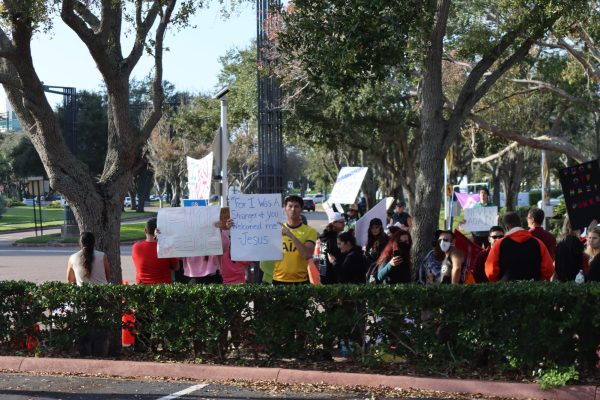
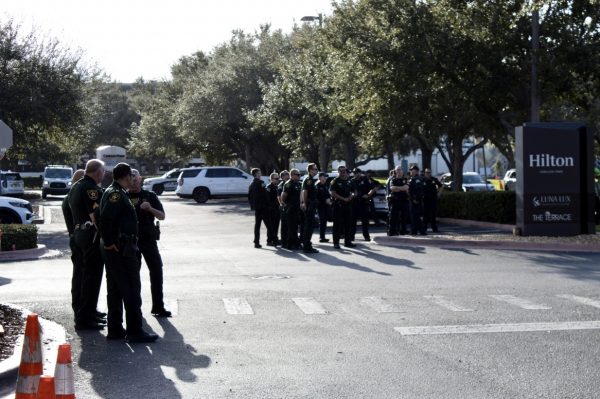
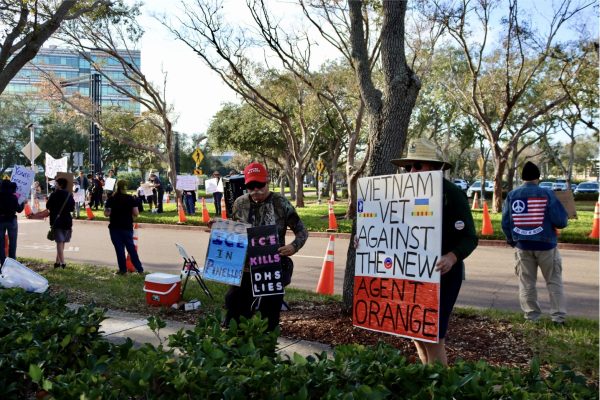
Situations like this have rallied communities together for a cause and inspired a bevy of protests against ICE around the nation. One of many took place on Jan. 13 outside the Hilton at Carillon Park, St. Pete, in an attempt to interrupt an ICE recruitment event.
“There’s a lot to protest, there’s a lot to hate, there’s a lot to be upset about. You know the old saying, ‘If you’re not outraged, you’re not paying attention,’” an impassioned local protestor Alexander Symington said. “Shooting a young mother in the head three times and calling her a ‘f— b—?’ That is not America. That’s not the America I grew up in.”
This young mother he mentioned, Renée Good, whose name has become a rallying cry, is now a martyr for a movement that feels it is fighting for the soul of the United States. Her death, the death of many others like her and the viral videos of ICE officers during the encounters, have turned these news reports and operations into the tangible, raw, jagged reality of lives cut short. For students like Chloe, Renée isn’t just a news story; she’s a mirror reflecting the danger that haunts her family.
“Due process and human rights? That doesn’t exist anymore, and when there [are] no human rights, when there is no respect for due process, what is next? They are going to come after green card holders,” a Shorecrest community member and green card holder who has requested to remain anonymous said.
In seeing the spectacle, we often overlook a quieter reality, that members of our own community are living through these tragedies. These aren’t just news stories, they’re lived experiences of our community members.
“I wish I could switch places. I want to give my family the things I have that they were never able to experience. It’s just so hard to think that I’m going to be here in this nice school, being able to do things I want, but so much of my family is in Venezuela struggling just to survive,” Chloe said.